Quick Answer: Most hydroponic cannabis leaf problems trace back to pH-induced nutrient lockout — not an actual shortage of nutrients in your reservoir. Check pH and EC first, before adding anything, and you’ll solve the majority of issues faster than any other approach. Hydroponics has no buffering medium, so problems escalate 2–3× faster than in soil.
Why Hydroponic Cannabis Leaf Problems Are So Often Misdiagnosed
When growers spot yellowing leaves or brown tips, the instinct is to add more nutrients. That instinct is usually wrong. Grower experience and published hydroponic research consistently show that 60–70% of hydroponic cannabis leaf problems stem from pH drift locking out nutrients that are already present in the water. You don’t have a deficiency — you have a pH problem wearing a deficiency costume.
Soil has a natural buffering capacity that slows this process. Hydroponics has none. A pH swing that would take a week to cause visible damage in soil can trigger leaf symptoms within 24–48 hours in a DWC bucket. That speed is what makes systematic diagnosis so critical.
Always start here before touching your nutrient mix:
- ✅ Check pH (target 5.8–6.2 for most systems)
- ✅ Check EC/PPM against your growth-stage targets
- ✅ Identify which leaves are affected — old growth or new growth?
- ✅ Rule out environmental causes (light distance, temperature, humidity)
- ✅ Adjust nutrients only after the above are confirmed correct
How Your Hydroponic System Affects Leaf Problem Risk
DWC and RDWC: Fast Growth, Fast Problems
Deep Water Culture is the most popular hydroponic setup for cannabis, and for good reason — growth rates are exceptional. But roots suspended directly in nutrient solution mean any pH or temperature shift hits immediately. In RDWC, a single reservoir problem propagates to every plant at once, which can be devastating.
Root zone temperature is especially critical. Keep your reservoir between 65–72°F (18–22°C). Warmer water holds less dissolved oxygen and becomes a breeding ground for pythium (root rot), which shows up first as wilting and yellowing that doesn’t respond to any nutrient fix. An air pump running 24/7 is non-negotiable in DWC — aim for at least 1 watt of aeration per gallon of reservoir volume.
NFT and Aeroponics: Zero Buffer, Rapid Leaf Stress
Nutrient Film Technique and aeroponics offer outstanding oxygenation, but the trade-off is zero buffering. In NFT, roots only touch a thin film of solution — a pump failure of even a few hours causes rapid wilting and leaf stress. Aeroponics growers often see leaf symptoms appear within hours of a system imbalance, not days.
Ebb & Flow and Coco Coir: More Forgiving but Still Vulnerable
Ebb and flow systems give roots a dry period between floods, which provides some natural buffering. Leaf problems here often tie directly to flood frequency — too infrequent causes salt buildup around roots; too frequent keeps roots waterlogged and oxygen-starved. A general starting point is 2–4 floods per day under grow lights, adjusted based on how quickly your medium dries.
Coco coir behaves differently from true hydroponics because it has a natural cation exchange capacity. It binds calcium and magnesium ions, making Cal-Mag deficiency the dominant leaf problem for coco growers. Target pH 5.8–6.3 in coco — slightly higher than DWC — and always pre-charge fresh coco with Cal-Mag solution before planting.
Kratky Method: Passive Risk of Oxygen Deprivation
The Kratky method is elegant in its simplicity, but as water level drops, nutrient concentration drifts upward and the air gap below the net pot becomes the plant’s only oxygen source. Watch for drooping and yellowing lower leaves — signs of oxygen deprivation — and monitor EC carefully, since topping off disrupts the air gap ratio.
The 5 Most Common Hydroponic Cannabis Leaf Symptoms
Understanding mobile vs. immobile nutrients is the fastest diagnostic shortcut available. Mobile nutrients (N, P, K, Mg) relocate within the plant, so deficiencies show on older, lower leaves first. Immobile nutrients (Ca, Fe, Zn, B) can’t move once deposited, so deficiencies always appear on new growth first.
Interveinal Chlorosis: Yellowing Between the Veins
Leaf veins stay green while the tissue between them turns yellow. On older leaves, this points to magnesium deficiency — the classic pattern working upward from the bottom. On the newest growth, iron deficiency is the likely culprit, and it’s almost always caused by pH above 6.5 rather than iron actually being absent from the reservoir.
Leaf Curl and Clawing: Nitrogen Toxicity vs. Environmental Stress
Downward-curling leaf tips that look like claws are the signature of nitrogen toxicity — one of the most common problems in hydro because it’s easy to overfeed. Leaves turn dark green, almost unnaturally so, and tips curl under. High VPD (low humidity combined with high temperature) can cause similar curling, so check your environment before cutting nitrogen.
Tip Burn and Marginal Scorch: Nutrient Burn or Potassium Deficiency
Crispy brown tips on the fastest-growing shoots usually mean your EC is too high — classic nutrient burn. If the browning appears as a yellow-to-brown margin creeping inward on older leaves, potassium deficiency is more likely. The distinction matters: nutrient burn requires diluting your reservoir, while potassium deficiency requires adjusting your nutrient ratio.
Necrotic Spots and Brown Patches: Calcium Deficiency vs. Pathogen
Random brown spots on upper, newer leaves are the hallmark of calcium deficiency. Because calcium is immobile, it always hits new growth first, and the spots tend to be irregular and dry. Spots with yellow halos or a water-soaked appearance suggest a pathogen — bacterial or fungal — which requires improving airflow and reducing humidity rather than adjusting nutrients.
Purpling and Reddish Discoloration: Phosphorus, Temperature, or Genetics
Purple or reddish coloring on leaf undersides and stems can mean phosphorus deficiency, cold temperature stress, or simply genetics expressing themselves. Check your reservoir temperature first — anything below 60°F (15°C) triggers purple coloring in many strains even with adequate phosphorus. If temps are fine and the discoloration is spreading, check pH before adding a P supplement. Phosphorus locks out below pH 5.5.
Nutrient Management: Deficiencies, Toxicities, and Mixing
Macronutrient Ratios by Growth Stage
NPK ratios should shift meaningfully between stages. Vegetative growth favors roughly 3:1:2 N:P:K; flowering demands a shift to approximately 1:3:2 as nitrogen needs drop and phosphorus and potassium demands climb. Many hydroponic cannabis leaf problems during the transition to flower happen because growers don’t make this switch aggressively enough.
- Nitrogen deficiency: Yellowing from bottom up, older leaves first
- Nitrogen toxicity: Dark green clawing leaves — reduce your base nutrient dose
- Phosphorus deficiency: Purple stems and undersides; check pH first (locks out below 5.5)
- Potassium deficiency: Marginal scorch on older leaves; excess K blocks Ca and Mg uptake
Calcium and Magnesium: The Most Common Hydroponic Deficiencies
Cal-Mag is the most overlooked supplement in hydroponics, especially for growers using reverse osmosis water. RO water contains essentially zero calcium and magnesium, so every drop of nutrient solution starts from scratch. Always add Cal-Mag first when mixing — before any base nutrients — and target 150–250 PPM calcium and 50–100 PPM magnesium in your reservoir. A dose of 5 mL/gallon in veg and 3–4 mL/gallon in flower covers the baseline for most RO grows.
Micronutrient Lockout: pH Is Almost Always the Culprit
Most micronutrient problems aren’t true deficiencies — they’re lockout caused by pH being out of range. Iron, manganese, zinc, and copper all become unavailable above pH 6.5. Boron locks out below pH 5.5. The fix is almost always a pH correction, not adding more micronutrients.
| Micronutrient | Target PPM | Locks Out At |
|---|---|---|
| Iron (Fe) | 2–5 PPM | Above pH 6.5 |
| Manganese (Mn) | 0.5–2 PPM | Above pH 6.5 |
| Zinc (Zn) | 0.5–1 PPM | Above pH 6.5 |
| Boron (B) | 0.5–1 PPM | Below pH 5.5 |
EC Targets by Growth Stage
| Growth Stage | Target PPM (500 scale) | Target EC |
|---|---|---|
| Seedling / Clone | 100–350 PPM | 0.2–0.7 EC |
| Early Vegetative | 400–700 PPM | 0.8–1.4 EC |
| Late Vegetative | 700–1000 PPM | 1.4–2.0 EC |
| Early Flower | 1000–1400 PPM | 2.0–2.8 EC |
| Peak Flower | 1200–1600 PPM | 2.4–3.2 EC |
| Late Flower / Flush | 0–400 PPM | 0.0–0.8 EC |
Going above 1800 PPM (3.6 EC) reliably causes nutrient burn. Dropping below 400 PPM (0.8 EC) during active growth causes generalized yellowing that looks like a deficiency but is really starvation.
Correct Nutrient Mixing Order
Mixing nutrients in the wrong order causes precipitation — you end up with cloudy water and nutrients that are no longer bioavailable. Always follow this sequence:
- Start with plain water (RO or filtered)
- Add Cal-Mag and mix thoroughly
- Add Part A (or Micro) and mix
- Add Part B (or Grow/Bloom) and mix
- Add any additives (silica, enzymes, beneficial bacteria)
- Adjust pH last, always
- Wait 15–30 minutes, then do a final pH check before use
pH Management: The Root Cause of Most Leaf Problems
Ideal pH by System Type
- DWC / RDWC / NFT / Aeroponics: 5.8–6.2
- Ebb & Flow: 5.8–6.2
- Coco coir: 5.8–6.3
- Kratky: 5.8–6.2
Choosing and Calibrating a Reliable pH Meter
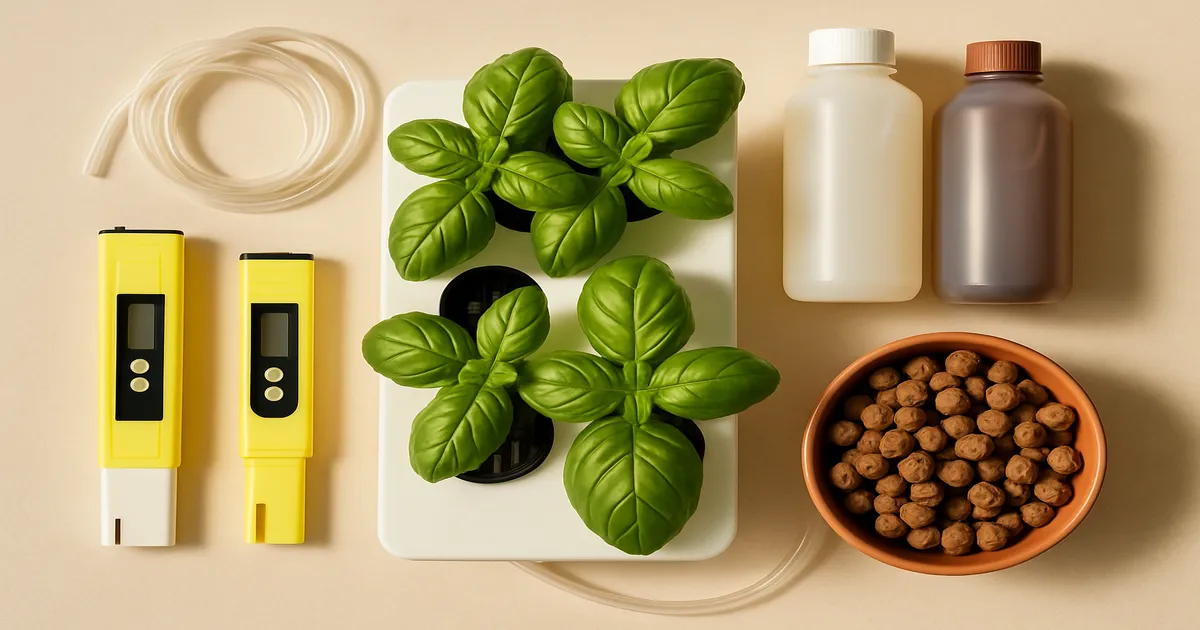
A cheap pH meter is worse than no pH meter — it gives you false confidence. Invest in a quality meter and calibrate every 7–14 days using pH 4.0 and 7.0 buffer solutions. Always store the probe in proper storage solution, never dry and never in plain water. (Apera Instruments PC60) (Bluelab pH Pen)
How to Adjust pH Without Shocking Your Roots
Never pour concentrated pH Down directly into your reservoir. Dilute it 1:10 in water first, then add in small increments — 1–2 mL at a time for a 5-gallon system. Stir, wait five minutes, recheck. Patience here prevents localized acid shock to your roots. Note that potassium hydroxide-based pH Up contributes potassium to your solution, so account for that extra K in your nutrient calculations if you’re using it heavily.
Why Your pH Keeps Drifting
| Symptom | Most Likely Cause | Fix |
|---|---|---|
| pH rising steadily | Plants consuming acidic nutrients; algae growth | Top off with slightly acidic water; eliminate light leaks |
| pH crashing rapidly | Bacterial bloom; dead roots decomposing | Full reservoir change; sterilize system |
| pH swinging wildly | Meter needs calibration; reservoir too small | Recalibrate; increase reservoir volume |
| pH stable but leaves show deficiency | Wrong meter scale; nutrient antagonism | Verify with a second meter; check individual ratios |
Larger reservoir volume is one of the most underrated stability tools. A 20-gallon reservoir resists pH swings far better than a 5-gallon bucket — simple dilution physics.
Environmental Causes of Hydroponic Cannabis Leaf Problems
Light Burn and Bleaching
High-powered LEDs can deliver far more light than cannabis can use, especially at close range. Light burn shows as bleaching or white/yellow discoloration on the tops of canopy leaves closest to the fixture — tips pointing toward the light turn pale while the rest of the leaf stays green. Keep seedlings and clones at 100–300 µmol/m²/s and peak flowering plants at 800–1,200 µmol/m²/s, adjusting light height accordingly. Note that some high-performance strains can handle up to 1,500 µmol/m²/s with adequate CO2 and VPD, but start conservatively.
VPD: How Vapor Pressure Deficit Affects Leaf Health
VPD — the difference between how much moisture the air holds and how much it could hold — directly controls how hard your plants work to transpire. Low VPD (high humidity) causes tip burn and poor nutrient transport because transpiration slows. High VPD (low humidity with heat) causes leaf curl, claw, and wilting as plants close stomata to conserve water.
Target VPD of 0.8–1.2 kPa in vegetative growth and 1.0–1.5 kPa in flower. A quality temperature and humidity meter paired with a VPD chart takes the guesswork out of this entirely.
Root Zone Temperature and Oxygen
Roots absorb nutrients most efficiently between 65–72°F (18–22°C). Above 75°F (24°C), dissolved oxygen drops sharply and pythium risk skyrockets. You’ll see leaf symptoms — yellowing, wilting — that look like nutrient problems but are actually root dysfunction. In warm grow rooms, a reservoir chiller is worth the investment.
Step-by-Step Diagnosis for Hydroponic Cannabis Leaf Problems
Step 1: Check pH and EC first. Pull a water sample and measure both immediately. If pH is outside 5.8–6.2, that’s your problem — correct it before doing anything else.
Step 2: Identify which leaves are affected.
- Old/lower leaves first → mobile nutrient issue (N, P, K, Mg)
- New/upper leaves first → immobile nutrient issue (Ca, Fe, Zn, B) or pH lockout
- Uniform across the whole plant → environmental cause or severe pH problem
- Random spots → calcium deficiency, pathogen, or physical damage
Step 3: Match symptoms to the most likely cause. Cross-reference leaf position with the symptom descriptions above. A yellowing lower leaf with no spots points to nitrogen or magnesium. A yellowing upper leaf with green veins points to iron lockout — check your pH before reaching for an iron supplement.
Step 4: Make one change at a time. Changing pH, EC, and light distance simultaneously makes it impossible to know what fixed the problem. Adjust one variable, wait 48–72 hours, then reassess.
Step 5: Document everything. Keep a simple grow log with daily pH, EC, reservoir temperature, and any changes made. Patterns become obvious quickly, and you’ll catch drift before it causes visible leaf damage.
Frequently Asked Questions
Why do my hydroponic cannabis leaves keep yellowing even though my PPM looks right? PPM tells you how much is dissolved — not whether the plant can access it. If pH is out of range, nutrients lock out regardless of concentration. Check pH first. If pH is correct, verify your meter is calibrated and confirm which scale it uses (500 vs. 700).
How quickly can a pH problem cause leaf symptoms in hydroponics? In DWC, visible leaf symptoms can appear within 24–48 hours of a significant pH swing. This is 3–5× faster than in soil. Daily pH checks during active growth are not excessive — they’re standard practice.
Should I flush my hydroponic system when I see leaf problems? Not automatically. Flushing makes sense when EC is confirmed too high (nutrient burn) or when salt buildup is suspected after a long reservoir cycle. If the problem is pH lockout, correct the pH first — flushing without addressing the root cause just delays the fix.
What’s the difference between nutrient burn and a potassium deficiency? Both cause brown leaf edges, but the pattern differs. Nutrient burn starts at the very tips of the fastest-growing new shoots and the leaves often look dark green. Potassium deficiency causes a yellow-to-brown margin that creeps inward on older, lower leaves. EC level is the quickest confirmation: high EC points to burn, low-to-normal EC points to deficiency.
Can I reuse hydroponic nutrient solution, or should I change it weekly? Change your reservoir completely every 7–14 days under normal conditions. In warm environments (reservoir above 75°F / 24°C), change every 5–7 days. Reusing solution beyond two weeks allows salt imbalances and bacterial populations to build up, making leaf problems harder to diagnose and fix.