Quick Answer: Deep water culture (DWC) is a hydroponic method where plant roots hang directly in an oxygenated, nutrient-rich water solution around the clock. An air pump and air stones keep dissolved oxygen high enough for roots to thrive while submerged. The result is faster growth, simpler mechanics, and one of the most beginner-accessible hydroponic setups available.
What Is Deep Water Culture?
The One-Sentence Definition
Deep water culture suspends plant roots 24/7 in an aerated, nutrient-rich reservoir — no soil, no periodic flooding, just roots bathing continuously in oxygen-saturated solution.
How DWC Differs from Other Hydroponic Systems
Most hydroponic methods deliver water intermittently. NFT (nutrient film technique) trickles a thin stream over roots. Ebb-and-flow floods and drains on a timer. Wick systems rely on passive capillary action. Deep water culture does none of that — roots stay submerged all the time, and aggressive aeration is what keeps them from drowning.
That combination of continuous submersion plus high dissolved oxygen is the defining characteristic. It’s also why the system has so few moving parts: one pump, one air stone, one reservoir, and you’re most of the way there.
Why Plants Grow Faster in DWC
When roots sit directly in oxygenated nutrient solution, they skip the work of pushing through soil or waiting for irrigation cycles. Nutrients are always available, oxygen levels stay high, and the plant redirects that saved energy into growth. Growers consistently report 30–50% faster vegetative growth compared to soil-grown counterparts — a difference that’s especially visible with fast-cycling crops like lettuce and basil.
How Deep Water Culture Works: Core Mechanics
Net Pots and Growing Media
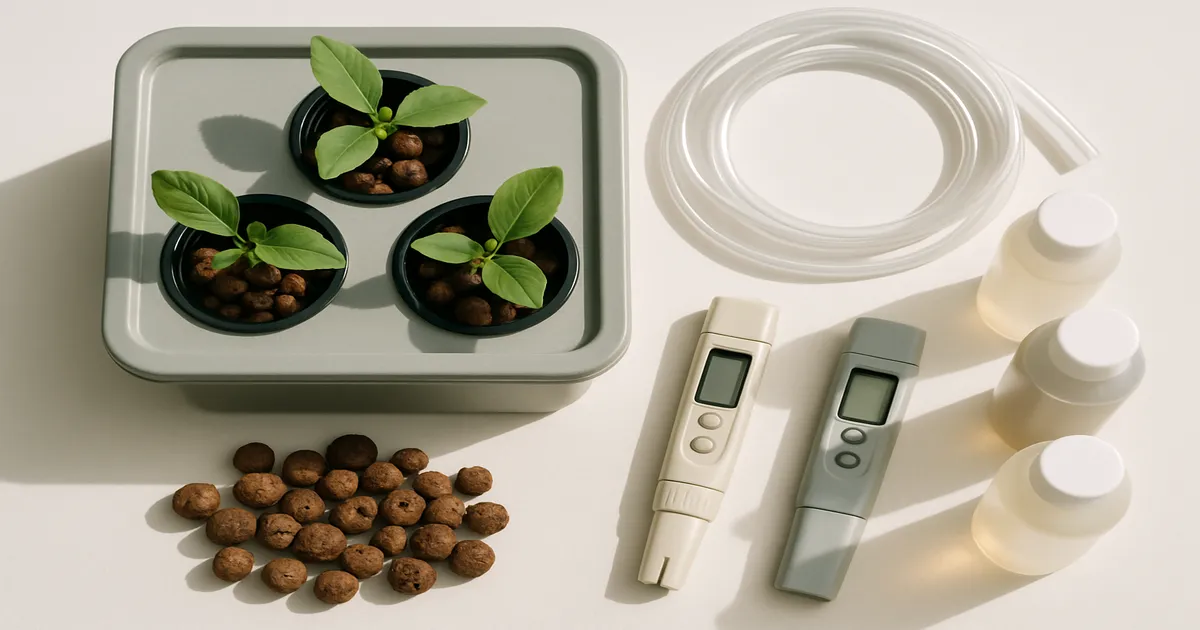
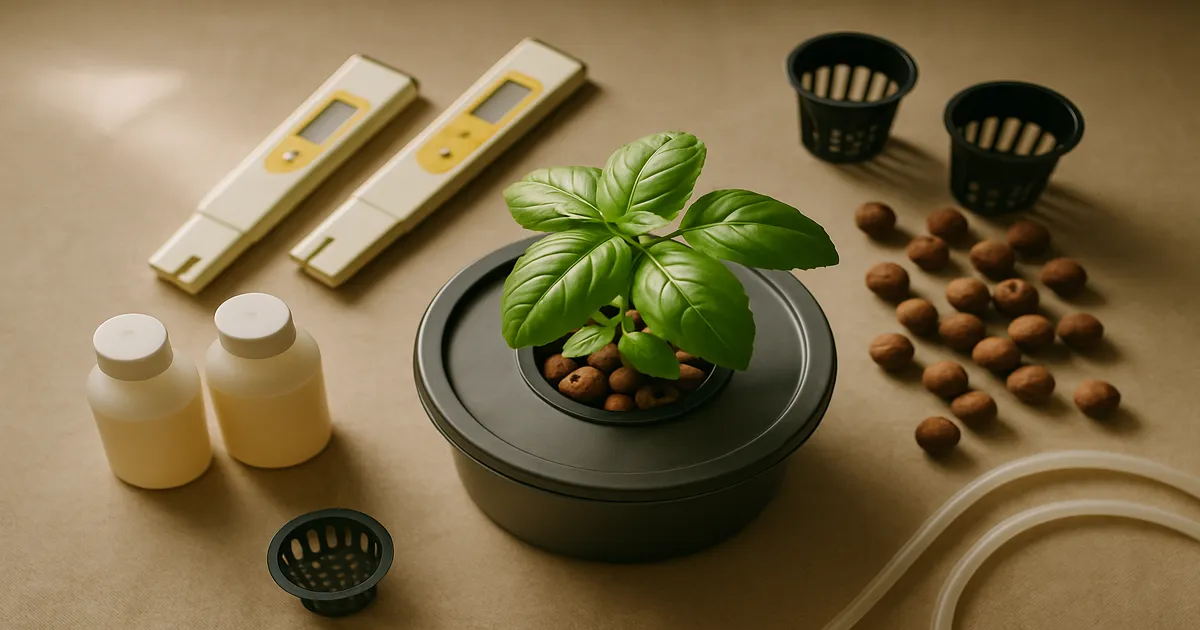
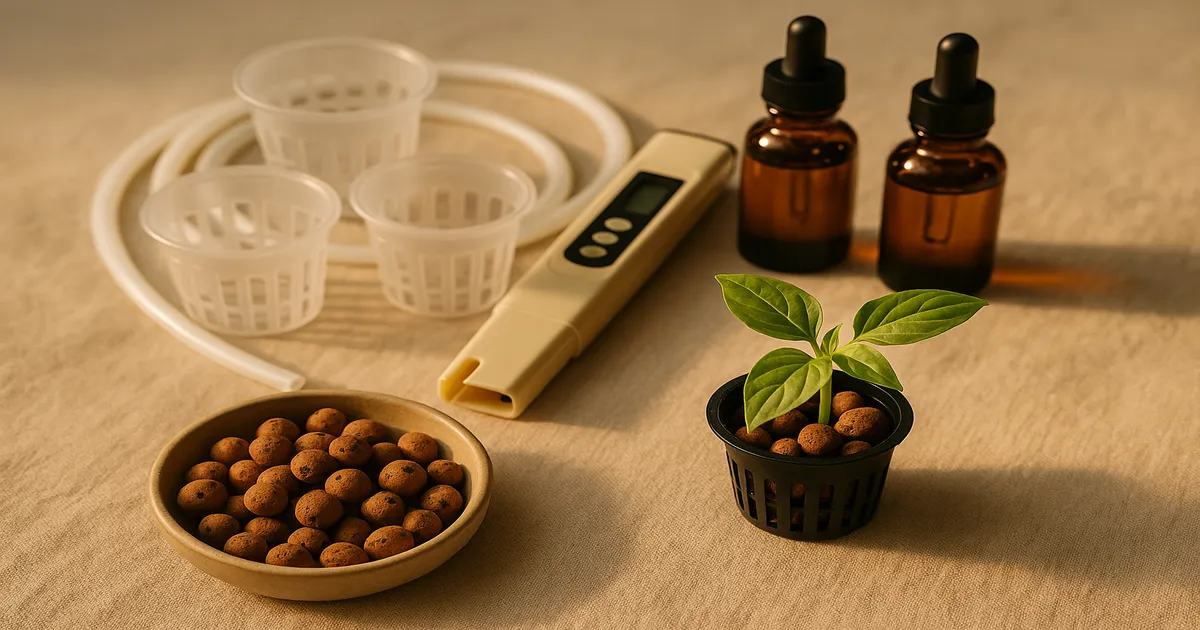
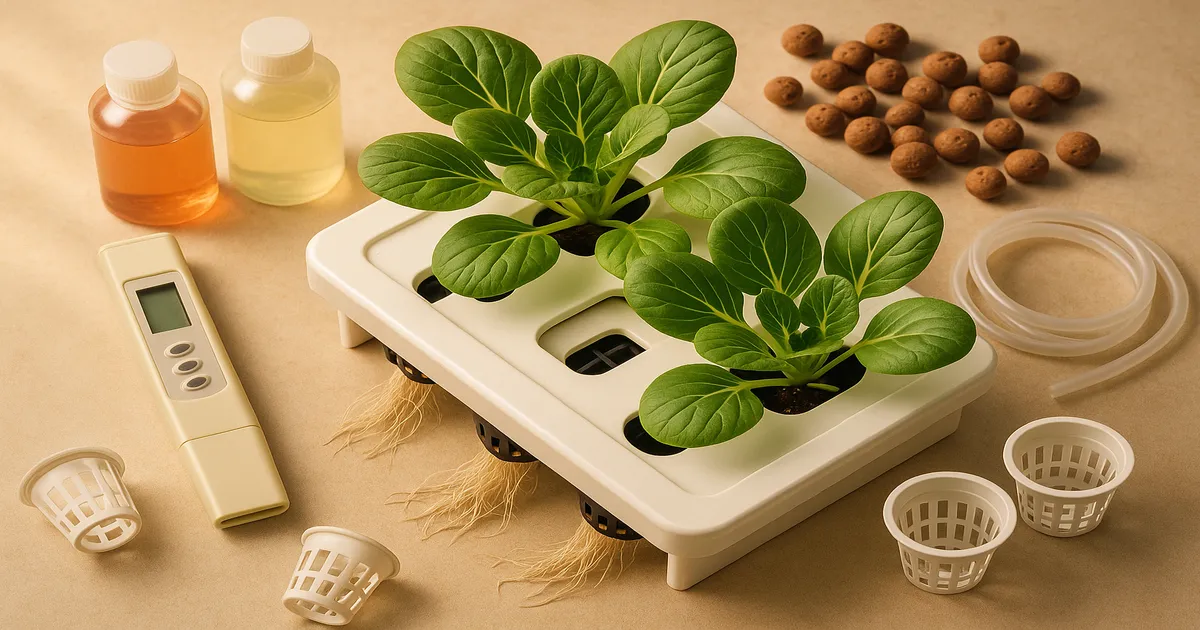
Plants sit in net pots — typically 2–3 inch mesh cups — that drop into holes cut in the reservoir lid. The net pot holds a small amount of inert growing medium (hydroton clay pebbles, rockwool, or coco coir) to anchor the seedling and wick moisture upward during early establishment. Roots quickly grow downward through the mesh and into the solution below.
Air Pumps, Air Stones, and Dissolved Oxygen
The air pump is the heart of the system. It pushes air through flexible tubing to an air stone or diffuser at the bottom of the reservoir, generating a constant stream of fine bubbles. Target 6–8 mg/L dissolved oxygen — the higher end of that range matters most in warm environments, where water holds less oxygen naturally.
The bubbles do double duty: they oxygenate the solution and create gentle surface agitation that promotes gas exchange. If your pump fails for more than a few hours, roots will feel it fast.
The Nutrient Reservoir: Size, Material, and Light-Proofing
Use a minimum 5-gallon reservoir per plant. More volume means slower pH and EC drift, which means less babysitting. The reservoir must also be completely opaque — any light reaching the solution will grow algae, which competes with your plants and crashes oxygen levels.
Black buckets or purpose-built DWC containers work well. If you’re repurposing a translucent container, wrap it in black and white poly film (white side out to reflect heat).
Types of Deep Water Culture Systems
There’s more than one way to run DWC. Here’s how the main variants compare:
| System Type | Description | Best For |
|---|---|---|
| Traditional Bucket DWC | One plant per 5-gallon bucket with its own air stone | Home growers, single large plants |
| Recirculating DWC (RDWC) | Multiple buckets connected to a central reservoir | Multi-plant grows, commercial scale |
| Kratky Method | Passive — no pump; uses an air gap above the solution | Ultra-budget herb and greens growing |
| Bubbleponics | DWC plus a top-feed drip ring for early seedling stage | Faster seedling establishment |
| Undercurrent DWC | Pressurized flow through connected buckets | Advanced/commercial growers |
The Kratky method deserves a special mention for budget growers. Instead of a pump, it relies on an air gap that forms naturally as roots consume the solution — roots in the water, roots in the air, no electricity required. It works well for lettuce and herbs but struggles with heavy-feeding fruiting crops.
RDWC and Undercurrent systems scale well but introduce more complexity — more tubing, more failure points, more monitoring. Start with a single bucket, master the fundamentals, then scale up.
Setting Up Your First DWC System
Equipment Checklist
- 5-gallon opaque bucket with lid
- 2–3 inch net pot (sized to fit your lid hole)
- Air pump (at least 1 watt per gallon)
- Air stone and flexible airline tubing
- pH meter and EC/TDS meter (Apera Instruments PH20)
- pH Up (KOH solution) and pH Down (phosphoric acid)
- Hydroponic nutrients (General Hydroponics Flora Series)
- Growing medium (hydroton or rockwool)
- pH 4.0 and 7.0 calibration buffer solutions
Assembling the Reservoir
Cut or drill a hole in the bucket lid sized to hold your net pot snugly — it should sit flush without falling through. Place the air stone at the bottom of the bucket, run the tubing up through a small notch in the lid, and connect it to the air pump outside the reservoir. Fill the bucket to about 1 inch below the bottom of the net pot.
Mixing Your First Nutrient Solution
If you’re on a budget, the Masterblend DIY recipe is hard to beat. Per gallon of water, mix:
- 2.4 g Masterblend 4-18-38
- 2.4 g Calcium Nitrate (15.5-0-0)
- 1.2 g Epsom Salt (MgSO₄)
This yields roughly 800–1,000 PPM (1.6–2.0 EC) — appropriate for late vegetative growth. Scale down proportionally for seedlings (target 100–250 PPM / 0.2–0.5 EC).
One important rule: always add silica first if you’re using it, before any other nutrients. Silica reacts with calcium if added out of order and can form a precipitate that won’t dissolve. After silica, add your base nutrients, then Cal-Mag, then any additives. Adjust pH last, targeting 5.8–6.0.
Transplanting Seedlings or Clones
Gently place your seedling (started in rockwool or coco) into the net pot and fill around it with hydroton. The hydroton should contact the nutrient solution or at minimum wick moisture up to the root zone. Keep the water level slightly lower in the first week so roots reach down for moisture rather than sitting in solution before they’re established.
Nutrients for Deep Water Culture
NPK Ratios by Growth Stage
During vegetative growth, aim for an NPK ratio around 3:1:2 — nitrogen-heavy to drive leaf and stem development. Flip to roughly 1:3:2 in flowering and fruiting, reducing nitrogen and boosting phosphorus to support flower and fruit set. Potassium stays consistently high throughout; it regulates stomata, drives enzyme activity, and directly affects fruit quality.
Calcium, Magnesium, and Why Cal-Mag Matters
Calcium and magnesium are frequently the first deficiencies DWC growers encounter, especially when using reverse osmosis or soft water. Target 200–300 PPM calcium and 50–80 PPM magnesium in your reservoir. A quality Cal-Mag supplement dosed at 3–5 mL per gallon usually covers this.
Calcium is critical for cell wall integrity — a deficiency shows up as tip burn on lettuce and blossom end rot on tomatoes. Don’t wait for symptoms to appear before supplementing.
EC and PPM Targets from Seedling to Harvest
| Growth Stage | PPM (500 scale) | EC |
|---|---|---|
| Seedling/Clone | 100–250 | 0.2–0.5 |
| Early Vegetative | 400–600 | 0.8–1.2 |
| Late Vegetative | 800–1,200 | 1.6–2.4 |
| Early Flower/Fruit | 1,000–1,400 | 2.0–2.8 |
| Late Flower/Fruit | 1,200–1,600 | 2.4–3.2 |
| Final Flush | 0–200 | 0.0–0.4 |
Note on PPM scales: North American meters typically use the 500 scale (the values above). Some meters use the 700 scale, which reads about 40% higher for the same solution. Check your meter’s manual so you’re comparing like for like.
pH and EC Management in DWC
Optimal pH Range
Keep pH between 5.5–6.2, with 5.8–6.0 as your everyday target. At the lower end (5.5–5.8), micronutrients like iron, manganese, and zinc become more available. At the higher end (6.0–6.2), calcium, magnesium, and phosphorus uptake improves. Running pH through a gentle daily cycle within that window — sometimes called “pH swinging” — can maximize overall nutrient availability.
Even a 0.3–0.5 unit swing outside your target can trigger visible deficiency symptoms within 24–48 hours. DWC is fast-paced; plants respond quickly in both directions.
Monitoring Tools and Calibration
A reliable digital pH pen is non-negotiable. Calibrate it every 1–2 weeks using pH 4.0 and 7.0 buffer solutions — a drifting probe gives false confidence, which is worse than no meter at all. Pair it with a TDS/EC meter to track nutrient concentration.
For RDWC systems or serious growers, inline monitors like the Bluelab Guardian provide continuous real-time readings and are worth the investment.
Adjusting pH Safely
- pH Down: Phosphoric acid is the standard choice — clean, plant-safe, and it adds a trace of phosphorus.
- pH Up: Potassium hydroxide (KOH) is preferred over sodium hydroxide, which adds sodium that accumulates over time.
Always add adjusters in small increments — 1–2 mL per 5 gallons at a time. Stir, wait 5–10 minutes, then retest. It’s easy to overshoot, and chasing pH up and down wastes time and stresses plants.
Reading pH Drift Patterns
pH drift is normal — roots consume nutrients and release metabolic byproducts that push pH around. Different patterns point to different problems:
| Pattern | Likely Cause | Fix |
|---|---|---|
| pH rising steadily | Plants consuming nitrogen; CO₂ depletion | Top off with slightly acidic water; partial reservoir change |
| pH crashing rapidly | Microbial bloom or algae die-off | Full reservoir change; eliminate light leaks |
| EC rising over time | Water evaporating faster than nutrients consumed | Top off with plain pH-adjusted water only |
| EC dropping rapidly | Fast nutrient uptake (healthy plants) | Add partial-strength nutrient solution |
| Wide daily pH swings | Soft/RO water; small reservoir volume | Add silica or Cal-Mag as buffer; increase reservoir size |
When EC rises, top off with plain pH-adjusted water. When EC drops, add a half-strength nutrient solution. Do partial water changes (25–50%) every 7–14 days to prevent salt buildup, and full reservoir changes every 2–3 weeks to keep chemistry clean.
Keep water temperature at 65–72°F (18–22°C). Warmer water holds less dissolved oxygen and accelerates the microbial activity that causes pH instability.
Best Plants to Grow in a DWC System
Beginner Crops: Lettuce, Herbs, and Leafy Greens
Lettuce is the gateway crop for deep water culture — fast to harvest (30–45 days), forgiving of minor pH swings, and low on nutrient demand (400–800 PPM / 0.8–1.6 EC). Spinach, kale, and Swiss chard perform similarly well. Herbs like basil and cilantro are excellent DWC performers with slightly higher light needs. Basil in particular responds dramatically to DWC’s fast growth environment — expect noticeably larger, more productive plants than you’d get in soil.
Intermediate Crops: Tomatoes, Peppers, and Cucumbers
Tomatoes, peppers, and cucumbers all thrive in DWC but demand more: higher PPM (1,000–1,600 / 2.0–3.2 EC at peak), more light (600–900 PPFD), and physical support structures for the plant’s weight. Indeterminate tomato varieties can get very large very fast — plan your vertical space before you plant.
Advanced Crops: Cannabis and High-Demand Fruiting Plants
Cannabis is one of the most popular advanced DWC crops, and the reason is straightforward: the explosive vegetative growth that DWC enables translates directly into larger yields. These plants want high PPM (1,200–1,600 during peak flower), strong light (600–1,000+ PPFD), and dialed-in pH. Mistakes are amplified at this level, which is why building experience on easier crops first pays off.
Lighting for Deep Water Culture Grows
Spectrum and PPFD Targets by Crop
Seedlings and vegetative plants thrive under blue-heavy light (5,000–7,000K). Flowering and fruiting crops want red-heavy output (2,700–3,500K) to trigger and sustain reproductive growth. Many modern LED fixtures also include far-red (700–750 nm), which boosts photosynthetic efficiency when paired with red light — a real-world benefit, not marketing fluff.
| Crop | Vegetative PPFD | Flower/Fruit PPFD | DLI Target |
|---|---|---|---|
| Lettuce/leafy greens | 200–400 | 300–500 | 12–17 mol/m²/day |
| Herbs (basil, cilantro) | 250–400 | 350–500 | 15–20 mol/m²/day |
| Tomatoes/peppers | 400–600 | 600–900 | 20–30 mol/m²/day |
| Cannabis | 400–600 | 600–1,000+ | 30–40+ mol/m²/day |
DLI formula: DLI = PPFD × photoperiod hours × 0.0036
Recommended LED Grow Lights
Under $150:
- Mars Hydro TS 1000 (~$100): 150W; covers 2×2 to 3×3 ft; excellent for leafy greens and herbs
- Spider Farmer SF-1000 (~$100): efficient quantum board; solid 2×2 ft coverage
$150–$500:
- Spider Farmer SF-2000 (~$250): 200W; 3×3 to 4×4 ft; ~2.7 µmol/J efficiency
- HLG 225 Rspec (~$350): premium quantum board; excellent flowering spectrum
$500+:
- HLG 650R (~$900): 650W full-cycle workhorse for serious growers
- Gavita Pro 1700e LED (~$1,100): commercial standard; 645W
One reminder: zero light must reach the reservoir. Use opaque lids, black tubing, and tape over any gaps. Light plus water equals algae, every time.
Frequently Asked Questions About Deep Water Culture
How often should I change the water in a DWC system? Do a 25–50% partial water change every 7–14 days to prevent salt buildup. Perform a full reservoir change every 2–3 weeks. In between, top off with plain pH-adjusted water when EC rises, or dilute nutrient solution when EC drops.
Can DWC work without an air pump? Yes — the Kratky method is a passive variation of deep water culture that uses no pump. An air gap forms naturally as roots consume the solution, providing oxygen to the upper roots. It works well for lettuce and herbs but isn’t reliable for heavy-feeding crops like tomatoes or cannabis.
What causes root rot in DWC, and how do I prevent it? Root rot is caused by Pythium and related water molds, which thrive in warm, low-oxygen water. Keep reservoir temperature at 65–72°F (18–22°C), maintain dissolved oxygen above 6 mg/L, and eliminate all light leaks. Adding beneficial bacteria like Hydroguard (Bacillus amyloliquefaciens) provides an extra layer of protection.
What’s the difference between DWC and RDWC? Traditional DWC uses one self-contained bucket per plant. Recirculating DWC (RDWC) connects multiple buckets to a central reservoir, circulating solution continuously through the system. RDWC makes pH and EC management easier across many plants but adds tubing, a water pump, and more potential failure points.
What pH should I maintain in a deep water culture system? Target 5.8–6.0 for everyday growing. The acceptable range is 5.5–6.2. Staying within this window ensures all major and minor nutrients remain available to the plant. Check pH daily, especially in the first few weeks while you learn how your system drifts.